
Antonio Cerrito Archtop Guitar
Largely unknown in the world of vintage guitars, Antonio Cerrito spent the early part of his career building flattops for New York’s Oscar Schmidt company. The L-5 style guitar featured here is one of just a handful of documented archtops made by Cerrito (we know of just two examples) and as such hardly represents a ‘rival’ to the Gibson L-5. Nevertheless, the fact that luthiers like Cerrito and D’Angelico were making L-5 style archtops demonstrates the influence of that model and – largely thanks to the exposure given to it by Eddie Lang – a growing demand in the early 1930s for what was by then regarded as the professional jazz guitarist’s instrument of choice.
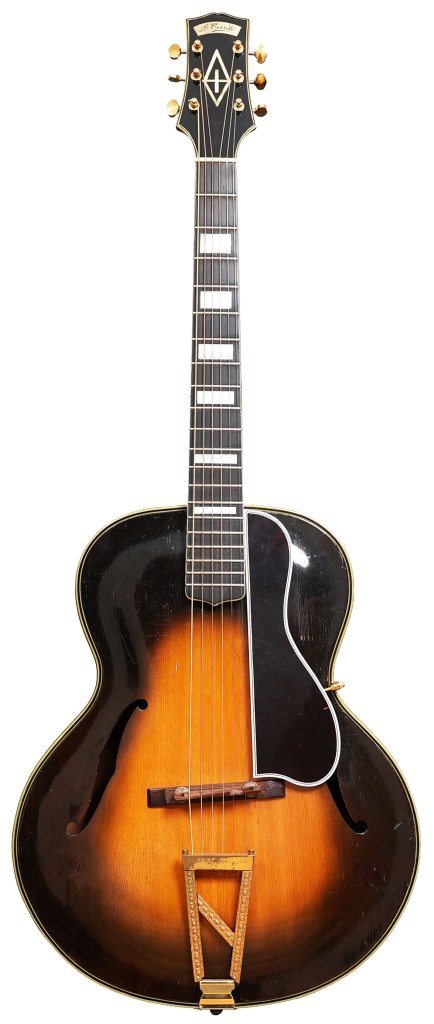
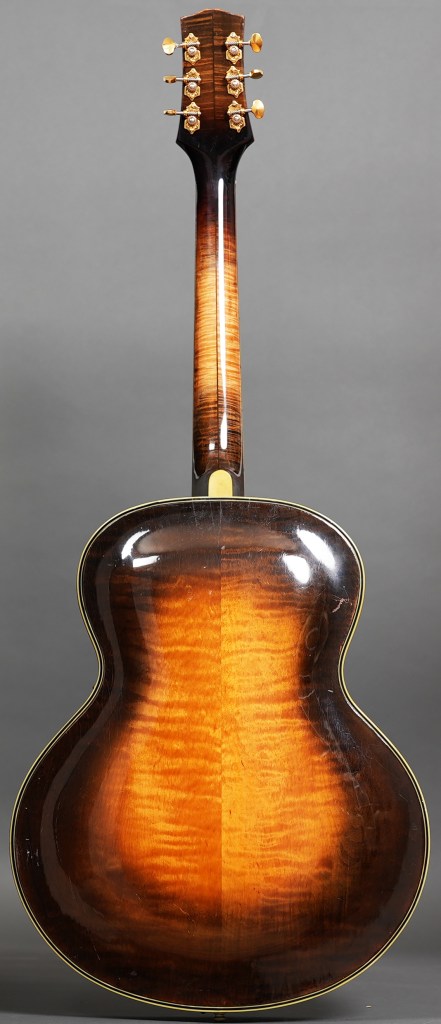
As stated above, the archtops built by Cerrito were clearly influenced by Gibson’s 16-inch L-5 and the example pictured here has a carved spruce top, carved, figured maple back, sides and neck, 14 frets clear of the body, an ebony fingerboard, an adjustable bridge and 24 ¾-inch scale length. The guitar has been refinished, the pickguard has been replaced and the tuners are modern Waverly copies of the Grover 98G ‘Sta-tite’ tuners that Gibson fitted to the L-5 in the early 1930s. The tailpiece (other than the base) is the original. The base was destroyed but it was possible to attach the remainder of the tailpiece to a new base.
We think that it dates from the early 1930s. Around 1930, the Gibson L-5 – on which the Cerrito archtop is closely based – switched from a fingerboard inlaid with simple pearl dots to one carrying a series of large pearl (sometimes celluloid) block inlays. Around the same time, the company began installing individual Grover 98G tuners. Though the tuners on this guitar have been replaced there is no evidence to suggest that it was ever equipped with the three-on-a-strip Waverly tuners that Gibson fitted to the L-5 in the late 1920s. It is highly unlikely that the Cerrito archtop would have predated the changes made by Gibson.
In addition, the Cerrito archtop is similar in appearance to the 16-inch archtops built by John D’Angelico, which are usually dated to the early/mid 1930s. Paul William Schmidt, author of the book ‘Acquired of the Angels’, comments that D’Angelico’s first instruments were built after he had opened his shop at 40 Kenmare Street at the age of 27 (D’Angelico was born in 1905).
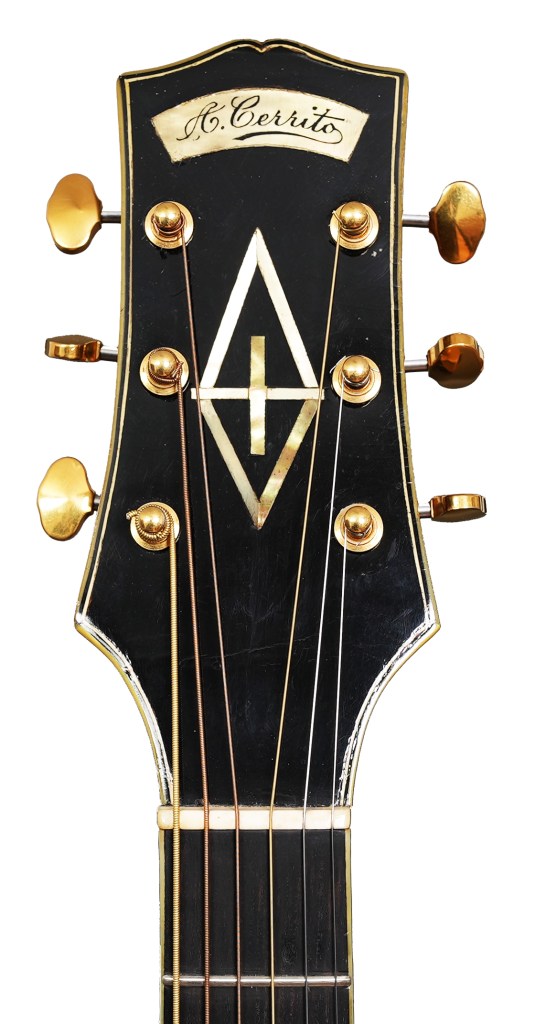


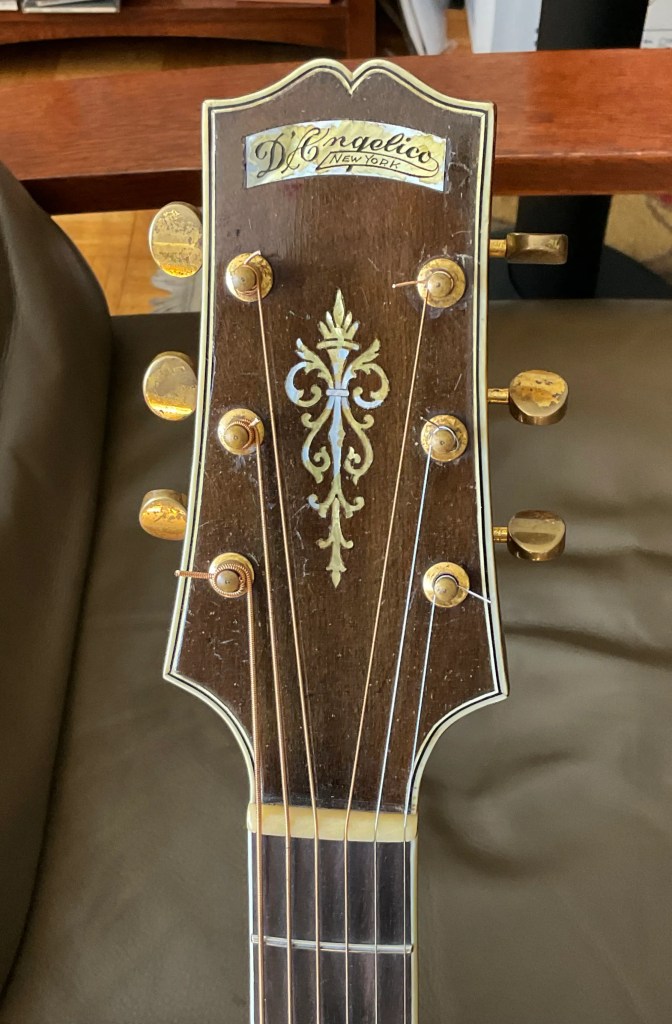
Note the similarity of the headstock name plaques used by John D’Angelico and Antonio Cerrito (see image below).

Images courtesy of Schoenberg Guitars