
by Lynn Wheelwright and Paul Alcantara

Just as Leo Fender’s plank-like Telecaster prompted Gibson President Ted McCarty to initiate the development of the Les Paul solidbody in the early 1950s, so another California-based company, Electro String Instruments, had pushed Gibson to design and market its first electric guitar almost two decades earlier.
Co-founded on 15 October 1931 by George Beauchamp, Adolph Rickenbacker and Paul Barth (all three of whom had previously been involved in the production of National’s metal bodied resonator guitars), the Ro-Pat-In Corporation – later known as the Electro String Instrument Company – was formed to develop the electric guitar that Beauchamp had designed.
The concept of electrically amplified stringed instruments was by no means new. Lloyd Loar (the man responsible for Gibson’s groundbreaking L-5 guitar and F-5 mandolin) and Lewis Williams – both of whom had previously worked at Gibson – had already investigated the possibility of electric musical instruments and were distributing their guitars and amplifiers under the ViVi-Tone brand name by the early Spring of 1932.
Unlike the device fitted to Loar’s instruments, which sensed the vibration through the bridge resulting in a performance that was weak and ineffective, Beauchamp’s magnetic pickup converted the string’s vibration directly into an electrical signal.
Introduced in 1932, the Rickenbacker A-25 Hawaiian guitar had a 25-inch scale (the A-22, which had a shorter 22 ½ inch scale, was added the following year). Both models were characterised by a round body made from cast aluminium that earned them the ‘frying pan’ nickname. Around the same time, Rickenbacker offered an electric “Spanish’ guitar that employed an identical pickup installed in a flat-topped, laminated body supplied by Harmony.
With just 13 Hawaiian guitar and amplifier sets and four ‘Spanish’ sets sold in 1932, Rickenbacker’s electric guitars hardly set the world alight. Nevertheless, the ‘frying pan’ caught the attention of Hawaiian players and by 1934, sales had risen significantly. The following year, Electro String Instruments produced an impressive 1,288 units (this total includes 12 violins and probably some Spanish guitars).
Piezo Pickup
Gibson’s first tentative step into the electric arena came in 1933 with the introduction of a piezo pickup that could be attached to an existing instrument without altering its acoustic tone. The set came with an amplifier that was about eight inches high, 12 inches long and six inches deep and weighed approximately eight pounds. Gibson appears to have begun shipping the piezo units in the Spring of 1933 and by the time that the new ‘Charlie Christian’ pickup had been developed in late summer of 1935, around 50 units had been shipped. The amplifiers’ serial numbers indicate that approximately 50 units were sold between March 1933 and the Summer of 1935.
Gibson Electric Hawaiian Guitar
No doubt aware of Rickenbacker’s electric instruments, Gibson’s general manager Guy Hart initiated an R & D project, the object of which was to come up with a commercially viable electric Hawaiian guitar and matching amplifier.
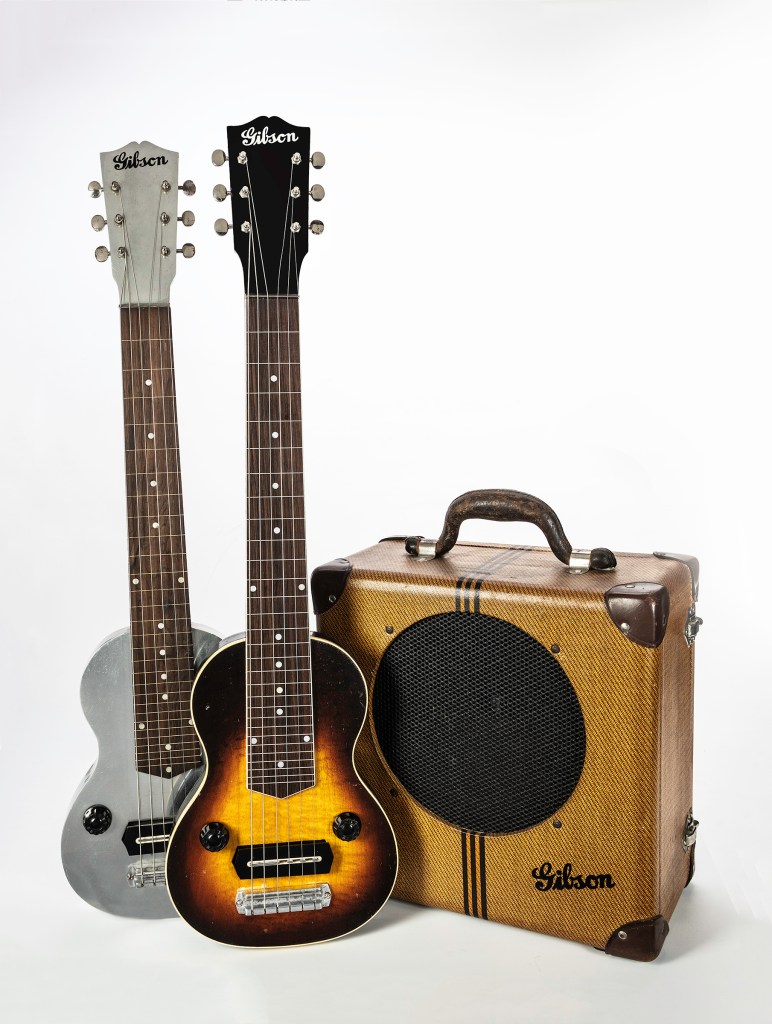
Gibson E-150 Hawaiian Guitar
The prototype E-150 Hawaiian Guitar was built of wood in the late summer of 1935. It is pictured here with an early aluminium E-150 and an early amp. “I believe that the E-150 was produced in aluminium at the insistence of Alvino Rey, who claimed that the wood version didn’t sustain like the Rickenbacker,” says Lynn Wheelwright. “Alvino was the face of the newly launched Gibson EH-150 and Gibson needed to be sure that he was happy. Indeed, he never used a wood bodied EH during the 1930s and when he was pictured playing a Gibson live, it was always a custom example made from aluminium or a combination of aluminium and wood.”
Image courtesy of Lynn Wheelwright
Research was initially carried out in collaboration with the Chicago-based Lyon and Healy Company, where an engineer by the name of John Kutalek was given the task of developing a suitable pickup. Steel guitarist Alvino Rey was taken onboard in an advisory capacity but after several months of unsuccessful experimentation, Guy Hart relocated the project to Gibson’s Kalamazoo factory.
Company employee Walter Fuller now replaced Kutalek as the man in charge of the new pickup’s development – and this time Gibson hit paydirt! Unlike Kutalek, who had based his design on the Rickenbacker pickup, Fuller went back to first principles, eventually arriving at a pickup that was economic to manufacture and, more importantly, sounded good.
Unveiled in October 1935, Gibson’s first production electric guitar acknowledged the influence of Rickenbacker with a cast aluminium construction. Initially referred to simply as the Gibson Electric Hawaiian guitar or E-150, it incorporated Walter Fuller’s pickup (today better known as the ‘Charlie Christian’ bar pickup), the bulk of which was hidden within the instrument’s body.
Gibson Electric Spanish Guitar
Encouraged by the success of the EH-150, which was by now built from wood rather than aluminium (the ‘EH’ indicating that it was an electric Hawaiian rather than Spanish model), Guy Hart had a similar pickup installed in one of the company’s acoustic guitars. Launched in December 1936 as the ES-150 (the guitar was priced at $150 with matching amp, case and cord), the new model was essentially a L-50 archtop fitted with Gibson’s new pickup, master tone and volume controls and a jack socket located at the base of the tailpiece. An earlier batch of ten ‘prototype’ ES-150s that featured a Black rather than Sunburst finish was manufactured from late October through November of 1936. Somewhat confusingly, these did not begin shipping until February of the following year.
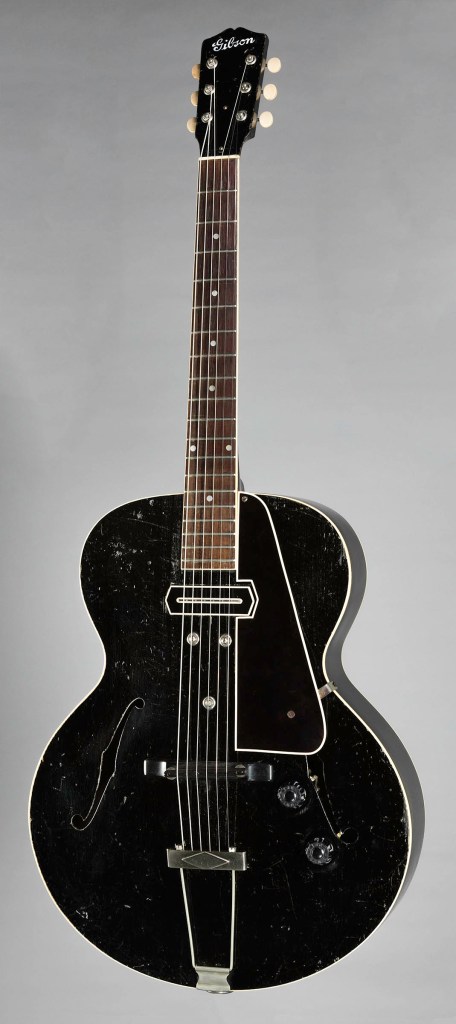
Black ES-150
The initial batch of ten ‘prototype’ ES-150s had an all-Black finish and a white-stencilled Gibson script logo on the headstock.in Realising that Black, which was used for the company’s budget models, might cheapen its entry into the electric guitar market, Gibson immediately switched to a more upmarket Sunburst finish. It’s interesting to note the placement of the ES-150’s pickup. Unlike the Spanish electrics from other manufacturers, which had the pickup positioned close to the bridge, the ES-150’s pickup was located at the end of the fingerboard. This produced a stronger bass response providing a warm, mellow sound that is favoured by jazz guitarists to this day.
Image courtesy of Lynn Wheelwright
Similar electric Spanish guitars were built by Gibson for the Montgomery Ward and Spiegel catalogue companies under the Recording King and Old Kraftsman brand names and judging from their FONs, production of these predates the ES-150 by a few weeks (though the initial samples were sent out to Montgomery Ward and Spiegel on 11 September 1936, the first production examples were not shipped to Montgomery Ward until 23 December 1936 and to Spiegel on 20 January 1937).
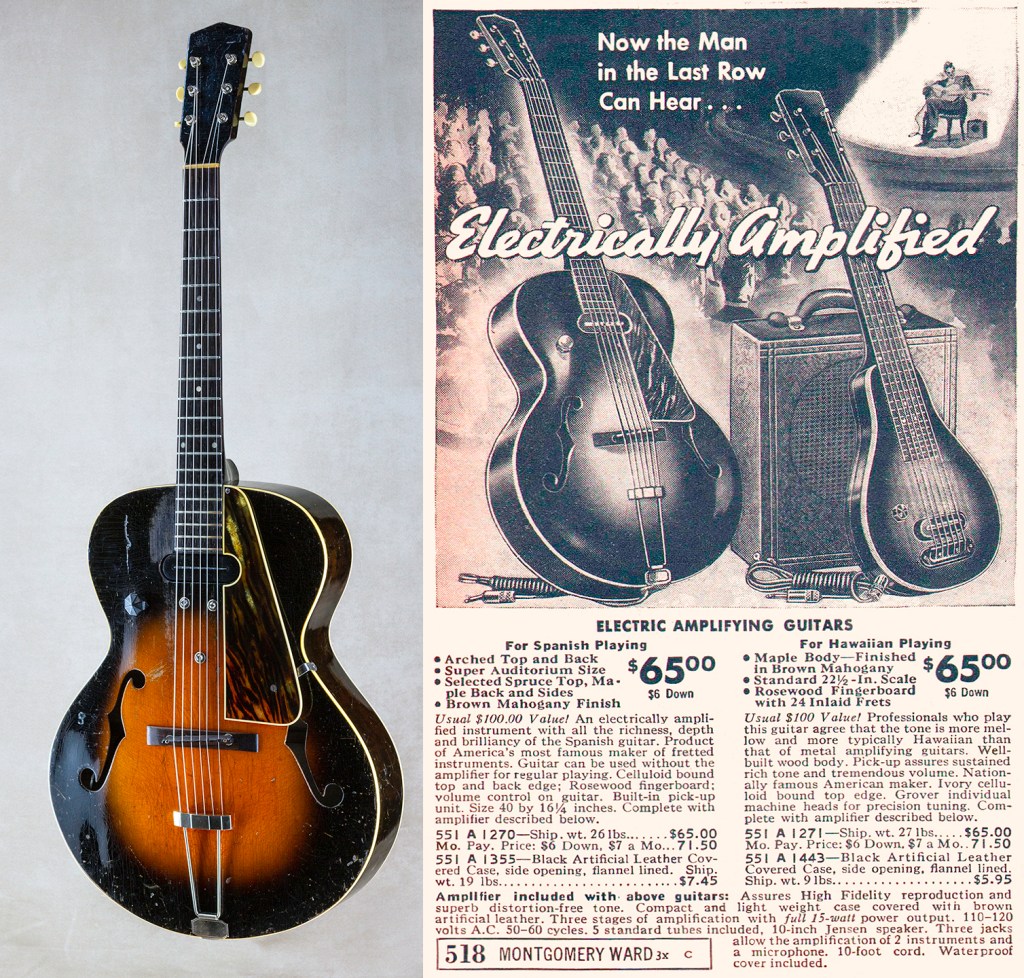

The electric Spanish guitars pictured above were built by Gibson for the Montgomery Ward and Spiegel catalogue companies under the Recording King and Old Kraftsman brand names. Images courtesy of Lynn Wheelwright
The fact that Gibson chose to enter the Spanish electric market with a 16 ¼ inch wide, mid-priced model that was initially painted Black with a white-stencilled Gibson script logo on the headstock, rather than one of its larger,
more up market guitars, suggests that Guy Hart was as-yet unconvinced that amplified musical instruments amounted to anything more than a passing fad. The acoustic guitar was regarded as a rhythm instrument at this time – a role amply catered for by the period’s 17-inch and 18-inch archtops. To guarantee the electric instrument a future, a player was required to unlock its potential.
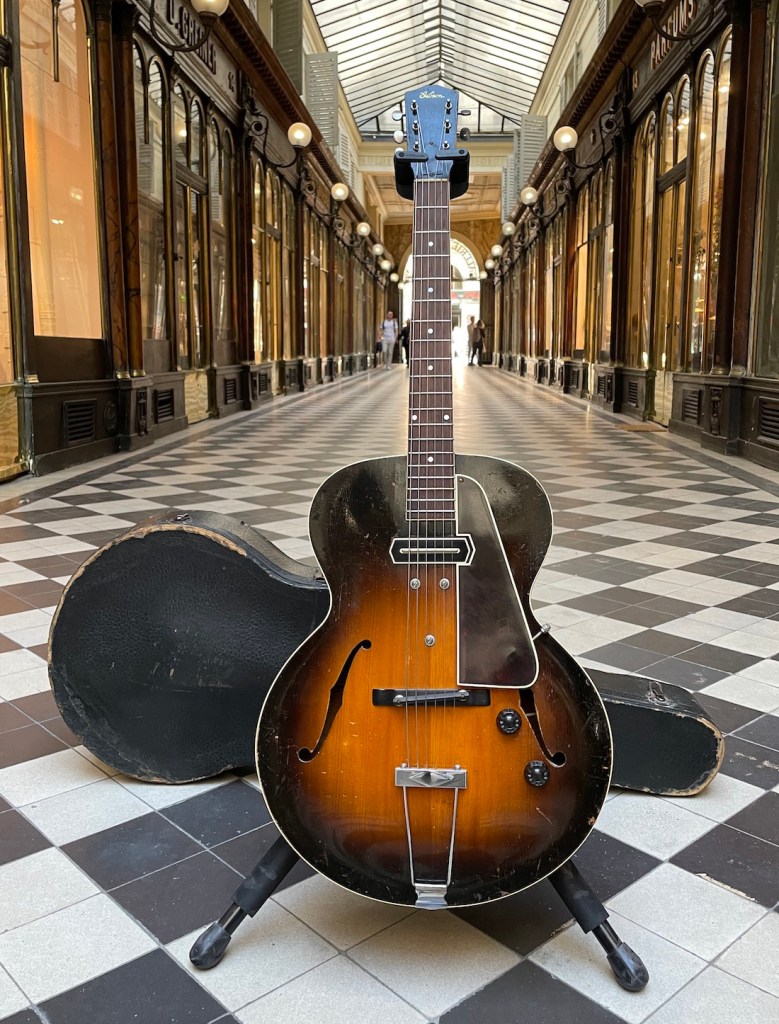
1937 Gibson ES-150
The production ES-150 now had a Sunburst finish, pearl-inlaid logo, individual tuners and a bound fingerboard. Other features included an X-braced carved spruce top and a flat maple back. Unlike the Montgomery Ward and Spiegel electrics, the ES-150 had an adjustable truss-rod.
Image courtesy of Galerie Casanova
Charlie Christian
The person to do his was a young black musician from Oklahoma City named Charlie Christian. Though not the first player to use an electric guitar, Christian was quick to recognise and exploit the instrument’s potential, coaxing fluid single line solos from his ES-150 in the manner of a saxophone or clarinet. Just as Hendrix would later wring sounds from the Stratocaster that Leo Fender could never have imagined, Christian’s use of the Gibson ES-150 redefined the guitar’s role in popular music, lifting it out of the rhythm section and establishing it as a legitimate solo voice.

Onward and upward
The ready acceptance of the ES-150 (504 units were shipped in 1937, its first full year of production) prompted Gibson to expand its electric Spanish line with two new guitars. The 14 ¾ inch wide ES-100 débuted in Gibson’s 1938 catalogue, while the 17-inch ES-250 followed a year later.
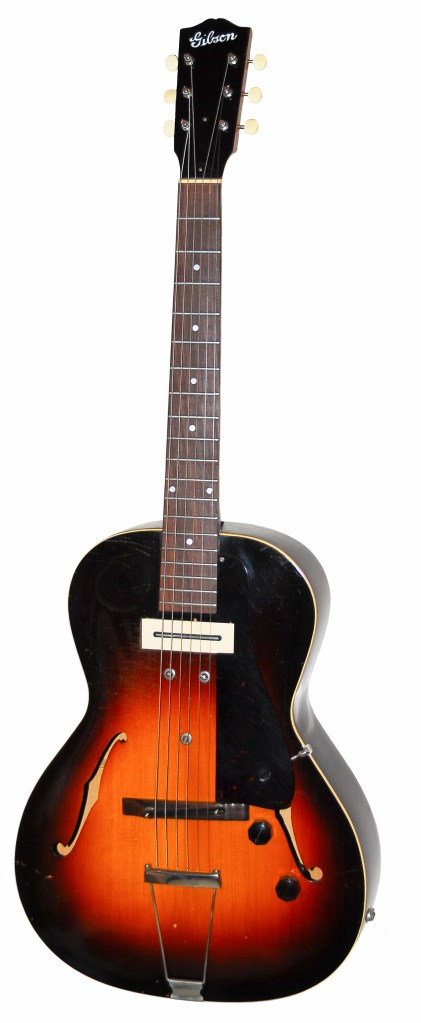
Gibson ES-100
Based on the acoustic L–37 archtop, the ES-100 was introduced in 1938. It featured a 14 3/4-inch wide body, a Sunburst finished carved spruce top and a flat back. Electronics comprised a neck position blade pickup with a white rectangular housing plus master tone and volume controls. The pictured example was shipped on May 29, 1939, to Glen Brothers Music.
Image courtesy of Lynn Wheelweight.

ES 150 pictured in Catalog X of 1937
Priced at $100 with a matching EH-100 amplifier, case and cord, the ES-100 was an economy model. By contrast, the ES-250, which retailed at $250 with an EH-185 amp, case and cord, was clearly a top of the line instrument. It featured a 17-inch ‘Advanced’ body size, a fancy pearl inlaid fingerboard and a large Super-400 style tailpiece. Not surprisingly, Charlie Christian and blues guitarist T-Bone Walker were quick to adopt the new model!
By the late 1930s, Gibson offered a variety of electric instruments all of which were fitted with variations on the Charlie Christian bar pickup. That the guitar would ultimately emerge as a dominant electric instrument was by no means clear at the time and Gibson hedged its bets by adding electric four string tenor and plectrum guitars, tenor, plectrum and five string banjos and two electric mandolins to its line. Strangest of all was an electric bass that combined a guitar-shaped maple body with the long scale length and extendable endpin of an acoustic bass fiddle (though a number of these basses have surfaced, the item was never catalogued).
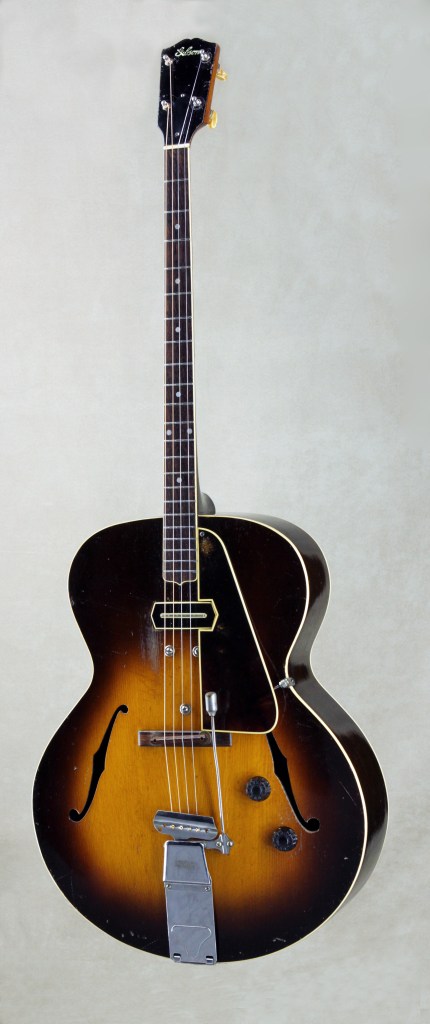
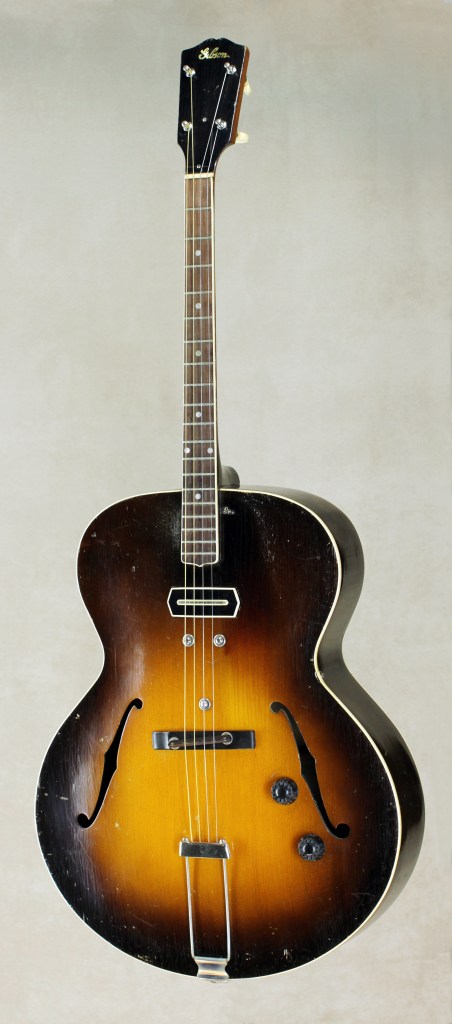
Plectrum and Tenor variants; Gibson built a single example of an ES-150 with a four-string plectrum neck, which was shipped 16 March 1937. A tenor version was introduced in April 1937 (images courtesy of Lynn Wheelwright).
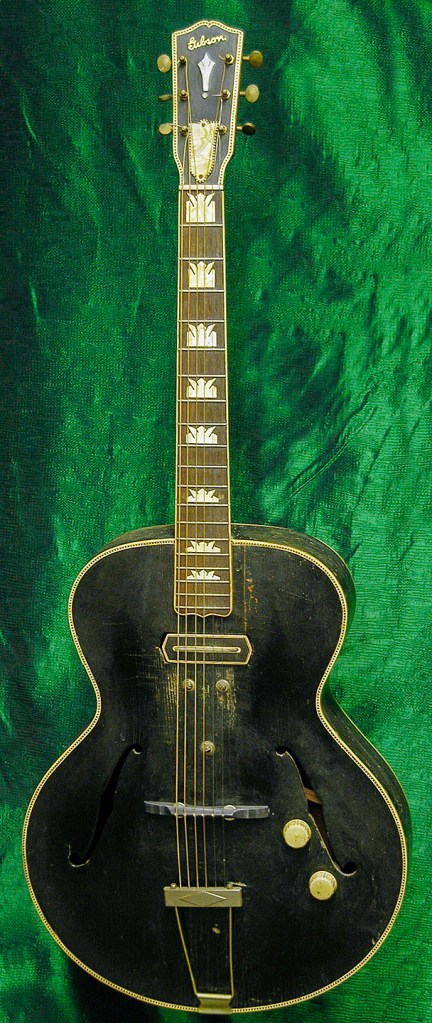
Custom Black ES-150
Though Gibson soon adopted a Sunburst finish for the ES-150, the company did continue to make the odd Black ES-150. The example pictured here was likely a special order or an employee model guitar. It was shipped around June of 1938.
Image courtesy of Lynn Wheelwright
Conclusion
Gibson was the first manufacturer to produce a commercially successful hollow-body electric guitar and as such, the ES-150 is an historically significant instrument. From a player’s perspective, the model feels surprisingly modern, with a comfortable, V-shaped neck and the same 24 ¾ inches scale length as a Les Paul or an ES-335. The ‘Charlie Christian’ pickup is noisy but it produces a tone that some notable jazz guitarists – Barney Kessel, Hank Garland and Tony Mottola among them – felt had never been equalled. Indeed, Gibson continued to offer the Charlie Christian pickup through the 1950s and into the 1960s as a custom order item and in the late 1970s introduced the ES-175 CC, which, as the name suggests, was an ES-175 hollow body fitted with a recreation of the Charlie Christian pickup.
Unlike many other electrics from the period, the pre-war ES-150 and ES-250 remain highly useable instruments and as a result are sought by collectors and players alike.
Join is the conversation and find out more on our new Facebook page

I became aware of the es150 when I purchased a 1973 es 150 DC in 1995. This sparked me to learn about the early Gibson es series and the playing of Charly Christian. I believe Gibson (Norlin?)made a huge error with the es150dc designation. The es150cd, the original es150 and Charly Christian would have been served with es150dc being in the catalog somewhere in the 320s, 330-5s, 340s, 350s series. Saying that, the es150dc is a splendid instrument. Wherever I perform with. the guitar people always come over to ask about it. I have met many people and players from all over thanks to this guitar.