
By Paul Alcantara
A question that we are often asked is: “Does the ‘L’ in L-5 stand for Loar”? That’s an easy one to answer. Gibson was using the ‘L’ prefix for various guitar models in its first catalogue of 1903, long before Lloyd Loar joined the company!
So where do the letter prefixes originate? They were not used by Orville Gibson who, according to Paul Fox, author of ‘The Other Brands of Gibson’, never used model names. “They may have been initiated by L. A. Williams,” Paul comments.
Let’s look at the letter names that the Gibson Company applied to the various mandolin, guitar and harp guitar models displayed in its 1903 catalogue.

The first advertisement for the 1903 Gibson Catalog, which appeared in the January, 1903 edition of Cadenza Magazine.
The model designations start with ‘A’ for the basic mandolins and proceed through the alphabet with the more expensive models always following the basic versions. Mandolins (A and F) are followed by mandolas (H) and mando-cellos (K). Next come the guitars (L and O) and finally harp-guitars (R and U). It’s also worth noting that the various instruments are, more or less, arranged in order of size, so that mandolins are followed by mandolas, which in turn are followed by mando-cellos and so on. The order is identical to that found in catalogue A of 1903.

Style A and A1 mandolins pictured in Gibson’s 1903 Catalog
All models are listed with a numerical suffix. For example, model A is followed by model A-1, which is followed by models A-2, A-3 and A-4. This applies to all the catalogued instruments except the F model mandolins. You’d expect to find an F-1 model positioned between the basic F model and the fancier F-2, but for some reason this isn’t the case.
27 instruments are listed in Gibson’s 1903 catalogue and at first glance, the various models appear to proceed alphabetically (see the diagram below). There are five A model mandolins, which takes us neatly to the letter F! Unfortunately, this system proves short-lived with ‘room’ for only two F model mandolins, one K model mandocello, three L style guitars and three O style guitars. For some reason the letter ‘T’ was excluded.
In the following diagram, the models that don’t fit the alphabetical scheme are listed above; the second line shows letters used for Gibson models in bold and the lower line shows the model designations. Note that the letter ‘T’ has not been used:

Perhaps the list was put together before the F-3 and F4 mandolins, K-1 and K2 mandocellos, L-3 and O-3 guitars were added to the line – although this still doesn’t explain the absence of an F-1 mandolin, or explain why the letter ‘T’ was excluded (unless an R-2 harp guitar was originally intended?)
Another possible explanation is that the instruments were originally listed in a ledger that had one page per letter except for G and K, which got three pages each and N and Q, which got two pages each. Once again, this doesn’t explain the absence of the F1 mandolin or why the letter ‘T’ was not used.
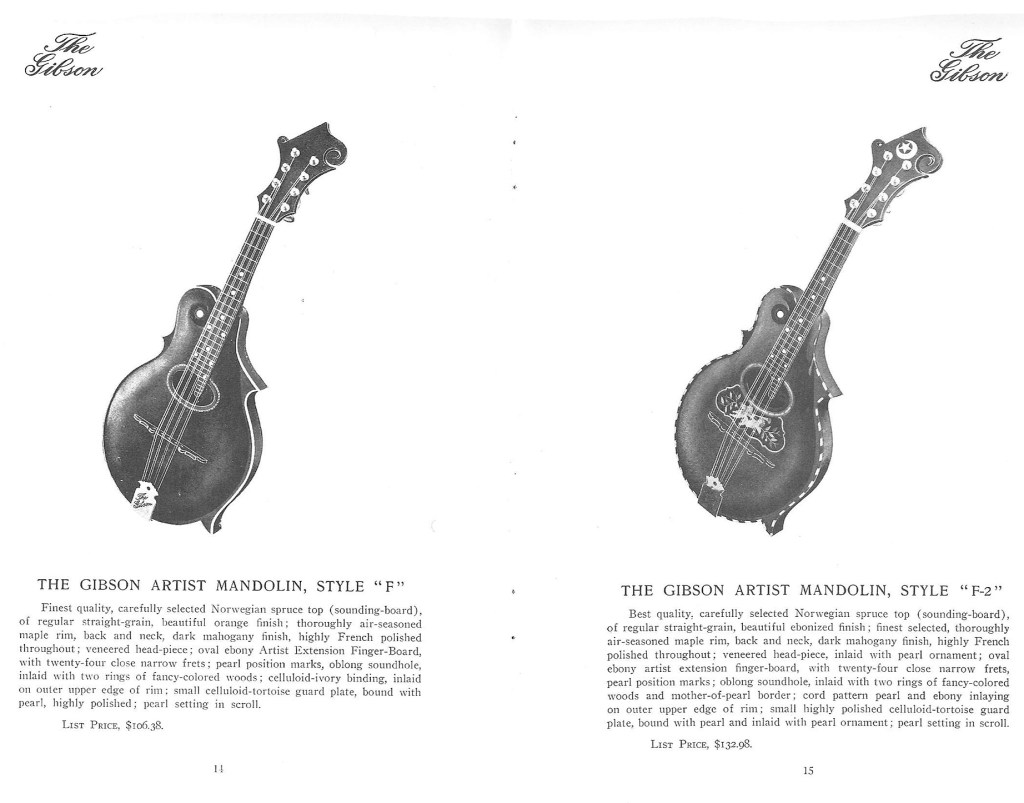
Gibson Models F and F2 pictured in Gibson’s 1903 Catalog
On page 64 of ‘Spann’s Guide to Gibson 1902-1941′, Gibson historian Joe Spann states that throughout the World War II period, Gibson purchased padded receipt books from a local stationery store for the purpose of initiating orders using a pre-printed form. Is it possible that during the early years of the company, Gibson used books similarly sourced from a local stationery outlet to record its various models? As with an address book, the number of pages allotted to the various letters may not have been uniform.
All of this is, of course, conjecture — and in the absence of period documentation, we may never know the thinking behind Gibson’s letter prefixes… though one thing’s for certain, the ‘L’ in L-5 DOESN’T stand for Loar”!
If you have any ideas, please contact us here!