
By Paul Alcantara.
You have bought or inherited a prewar Gibson archtop and are not clear what model it is or when it was built. Hopefully, the information presented below will help answer your questions! All of the featured examples were marketed with f-holes at some point.
The Gibson L-50
Introduced in 1932, the L-50 had a body that was 14 ¾ inches wide and 17 ½ inches long. While some were built with an arched back and f-holes, most had a round sound hole and a flat back. The model featured a dark Sunburst finish, a single bound top, an unbound back and a dot inlaid fingerboard. Details included a silkscreened Gibson logo, a short trapeze tailpiece, an ebony bridge and a pickguard that was glued to the top.
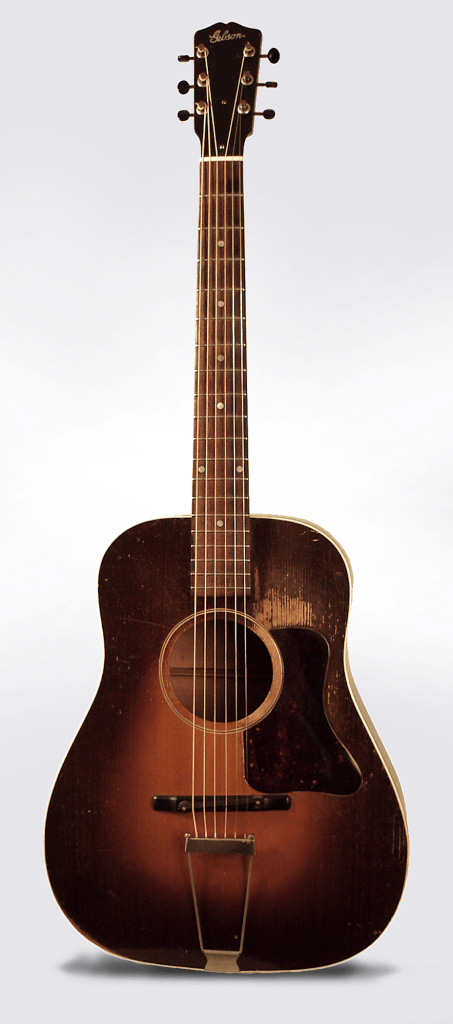

Early 1930s Gibson L-50. Only available for a short period, this first model L-50 had a wide-waisted body and large round soundhole. The pickguard was glued to the top rather than being elevated as on later examples. Images courtesy of Retrofret.
The following year saw the L-50 ‘s body length increased to 19 ¼ inches and f-holes become standard – though some examples were still shipped with a round sound hole. Both the top and back were now bound, the logo was inlaid in pearl, a regular trapeze tailpiece was fitted, and an elevated pickguard replaced the earlier glued item.


Mid 1930s Gibson L-50, now with a longer 19 ¼ inch body and f-holes. Images courtesy of Retrofret
In 1935 the model was upgraded with a body that was 16 ¼ inches wide (much like that of an early L-5), an arched back and the following year, a trapeze tailpiece with a raised diamond.


Mid 1930s Gibson L-50. The L-50 is a 16-inch archtop guitar with a flat back and rather plain appointments. Images courtesy of Retrofret.

Mid 1940s Gibson L-50. The ‘Banner’ on the headstock of this mid 1940s Gibson L-50 reads “Only a Gibson Is Good Enough” . Epiphone responded with the slogan: “When Good Enough Isn’t Good Enough”! Images courtesy of Retrofret.
In 1943 the crosspiece of the tailpiece was constructed from wood rather than metal. This was likely a result of restrictions due to WWII. For the same reason some examples were shipped without an adjustable truss rod. Other changes included three-on-a-strip tuners and a paint or decal logo with some examples displaying the ‘banner’ logo (“Only A Gibson is Good Enough”).
The postwar L-50 had a single bound pickguard and fingerboard, pearloid trapezoid fingerboard inlays and a decal logo. From 1949 the pickguard was laminated and had a bevelled edge. The model was discontinued in 1971.

1934 catalogue W, L-50 (above). The L-50 above is pictured in Gibson’s catalogue W of 1934 with a price tag of $50.00. It has a spruce top, maple back and sides, a mahogany neck, f-holes and a dot inlaid 19-fret rosewood fingerboard. The guitar sports a ‘deep red’ mahogany finish with a Sunburst top and a shaded neck. The body is described as being 14 ¾-inches wide and 19 ¼-inches long.

1937 catalogue X, L-50 (above). By the mid 1930s, the L-50 was upgraded with a body that was 16 ¼ inches wide and 20 ¼ inches long.
The Gibson L-30


Mid 1930s Gibson L-30. Note the Black lacquer finish and Kauffman Vib-Rola (which may or may not be factory). Images courtesy of Retrofret.
Added to the line in 1935, the L-30 had a body that was 14 ¾ inches wide and 19 ¼ inches long, a flat back, single bound top and back, an unbound elevated pickguard, dot inlaid fingerboard, a silkscreen logo and a Black finish – the latter replaced by a dark brown Sunburst top finish with mahogany back and sides in late 1936. The model was discontinued in 1943.

1937 catalogue Y L-30 (above). The L-30 is described in Gibson’s catalogue Y of 1937 as having maple back and sides and a 19 fret rosewood fingerboard. It is priced at $32.50
The Gibson L-37


1938 Gibson L-37. The Dymo type label affixed to the tailpiece crossbar reads “Blarney Stone” and was added by a previous owner at some point. Images courtesy of Retrofret.
1935 also saw the introduction of the L-37. Like the L-30 it had a body that was 14 ¾ inches wide and 19 ¼ inches long, a flat back, single bound top and back and a dot inlaid fingerboard. The pickguard was single bound and the top sported a red mahogany Sunburst finish, which, in 1937 was replaced by brown Sunburst with chocolate brown finish on the back and sides. The model was discontinued in 1941.

1937 catalogue Y L-37 (above). The L-37 is shown Gibson’s catalogue Y of 1937 with maple back and sides and a chocolate brown finish with a sunburst on both the top and rims. The model is priced at $40.00.
The Gibson L-75
Introduced in 1932, the L-75 had a body that was14 ¾-inches wide and 17 ½ inches long. It initially had maple sides and a flat maple back. Both the top and back were bound. Details included a short trapeze tailpiece, a dot inlaid fingerboard and a pearl logo.
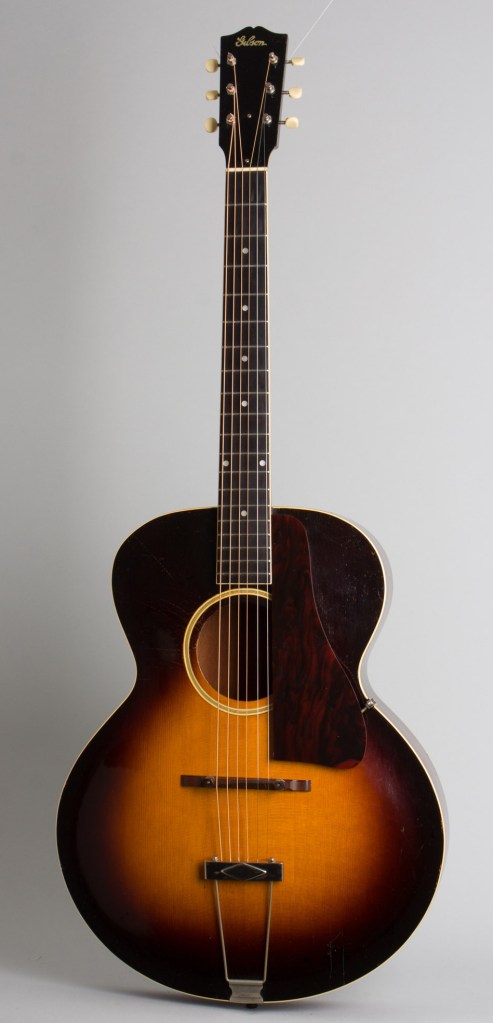
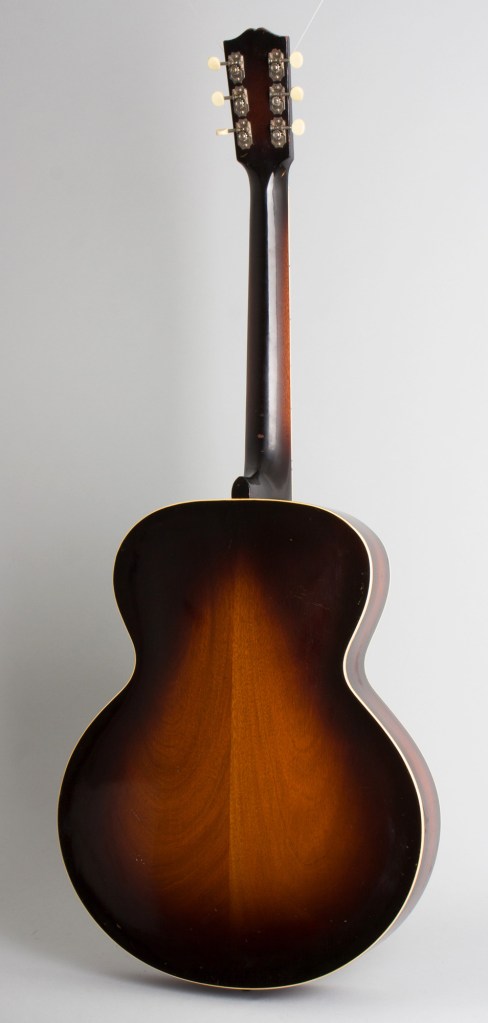
Late 1930s Gibson L-75. This guitar could easily be mistaken for to be an early/mid 1930’s L-4. Differences include the L-75’s back and sides, which are constructed of mahogany – unlike the L-4 which has maple back and sides. Images courtesy of Retrofret.
The following year mahogany replaced maple for the back and sides and by late 1933, a bound white pearloid fingerboard and pearloid headstock overlay (with a notched diamond inlay) were fitted. The fingerboard displayed fancy rectangular inlays.
The L-75 is described in in Gibson’s catalogue W of 1934 as having a body that is 14 ¾-inches wide and 19 ¼-inches long.
In 1935, the L-75 was upgraded with a 16 ¼-inch wide body, an arched back, a round soundhole, an elevated pickguard and a three-piece headstock inlay.
The model was discontinued in 1939.

1934 catalogue W L-75 (above). The L-75 is pictured in Gibson’s catalogue W of 1934 with a spruce top, “genuine mahogany” back, sides and neck and a dark brown mahogany finish with a Sunburst on the top, back and sides. Both the top and back are bound with white ivoroid. The body is14 ¾-inches wide and 19 ¼-inches long.
Details include f-holes, a 19-fret rosewood fingerboard, pearl fingerboard and headstock inlays, a regular trapeze tailpiece, an elevated pickguard, an adjustable bridge and nickel-plated metal parts including individual machine heads with ivoroid buttons. The headstock features a double handled vase inlay.

1937 catalogue X L-75 (above). The L-75 appears in Gibson’s 1937 catalogue X with a round soundhole, a body that is 16 ¼-inches wide and 20 1/4 inches long, mahogany back sides and neck, a dot inlaid 19 fret rosewood fingerboard and a pearl headstock inlay. The model has a dark brown finish with Sunburst shading on the top, back, rim and neck. The top, back and fingerboard are bound with white ivoroid. Hardware includes individual Grover tuners with white ivoroid buttons and an elevated pickguard. The model is priced at $75.00.
The Gibson L-47


1940 L-47. The L-47 was available with a Natural finish and tortoiseshell celluloid body binding or a Sunburst finish (on both the top and back) with white body binding. Images courtesy of Chicago Music Exchange.
Introduced in 1940, the L-47 had a body that was 14 ¾ inches wide and 19 ¼ inches long. The back was flat and both the top and back were bound. Details included white binding on the pickguard and a 19-fret dot inlaid fingerboard. The model was available with a Natural finish with tortoiseshell celluloid body binding or a Sunburst finish (on both the top and back) with white body binding. The L-47 was discontinued in 1942.

1942 catalogue BB L-47 (above). The L-47 is pictured in Gibson’s catalogue BB of 1942 with a body that is 14 ¾ inches wide and 19 ¼ inches long. It has maple back and sides, a mahogany neck and a 19-fret dot inlaid rosewood fingerboard. The model was available in a choice of “Cremona brown golden Sunburst” finish or Natural. Both the back and front had ‘shell’ binding. Details include an elevated pickguard with ivoroid binding, an adjustable rosewood bridge and nickel-plated metal parts including tuners with white buttons. The model was priced at $52.50 with a Sunburst finish or $57.75 with a Natural finish.
The Gibson L-48


Gibson L-48 late 1940s. This late 1940s L-48 has a spruce top. Earlier examples often had mahogany top, back and sides. Images courtesy of Gruhn Guitars.
Introduced in 1946, the L-48 had a 16 ¼ inch wide body with mahogany top, back and sides (some early examples with a spruce top). Both the top and back were single bound. Details included a dot inlaid fingerboard (some early examples with trapezoid fingerboard inlays), a silkscreen logo and a Sunburst finish. In the late 1940s a number of L-48s were shipped with a spruce top and maple back and sides.
In 1952 the model had a spruce top, a maple back with mahogany sides, a single ply tortoiseshell celluloid pickguard and three-on-a-strip Kluson Deluxe tuners.
By 1957 the L-48 had laminated mahogany top and sides. A laminated maple back was specified in the catalogue, but most were built with a mahogany back.
The model was discontinued in 1971.

1960 catalogue L-48 (above). The L-48 is pictured in Gibson’s 1960 catalogue with a body that is 16 ¼ inches wide and 20 ¼ inches long. It has an arched laminated mahogany top, an arched laminated maple back (see notes above) and mahogany sides, a one-piece mahogany neck and a 19-fret dot inlaid rosewood fingerboard. Other features include a rosewood adjustable bridge, nickel-plated metal parts – including enclosed machine heads – and a tortoiseshell plastic pickguard. The price by this point was $127.50.
The Gibson L-52
According to Gruhn’s Guide, the L-52 was available in the 1940s and was likely a Natural finish version of the L-50.
For further reading see Gruhn’s Guide to Vintage Guitars by George Gruhn and Walter Carter and Spann’s Guide to Gibson 1902-1941 by Joe Spann – both highly recommended!

