
By Paul Alcantara
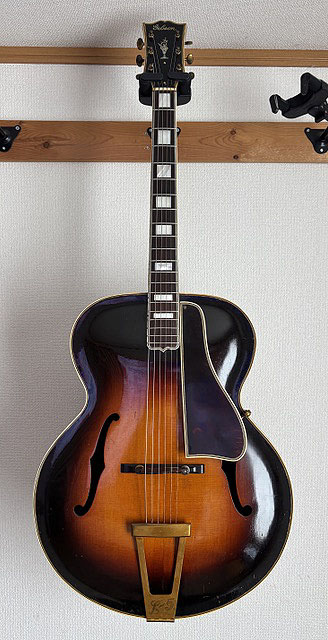
On close examination, what appears to be a regular mid 1930s 17-inch ‘Advanced’ L-5, is anything but! Though its FON (777B-2) dates this guitar to mid-year 1936 (the serial number is missing), it has parallel top bracing, which wasn’t introduced on the 17-inch L-5 until 1939 (the first ‘Advanced’ L-5s were X-braced). In addition, the neck is rather narrow with a nut width of 1.653 inches, while the width at the 12th fret is 2.047 inches.
Yet more puzzling is the fact that there is no access hole beneath the truss rod cover. The area beneath the cover is simply black-painted wood, matching the surrounding finish. It’s hard to figure how someone at Gibson didn’t spot this when the truss rod cover was attached! The guitar’s current owner has confirmed that a steel truss rod was installed by placing a magnet against the fingerboard between the 1st and 14th frets (see photos below).
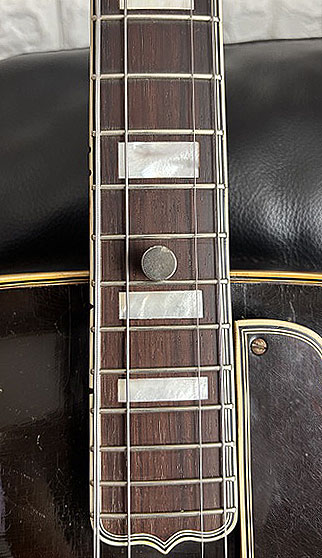
“I would suggest that this is a 1936 guitar which was returned to the factory during World War II for repairs and received a new neck at that time,” says Gibson historian Joe Spann (author of Spann’s Guide to Gibson 1902 to 1941). The fact that the fingerboard is rosewood rather than ebony supports this.
“The truss-rod was a Gibson invention and used exclusively by the company until 1945 when the patent expired,” Joe explains. “The off-brand instruments were not ‘real’ Gibsons and therefore did not have truss-rods.”
“I have seen many Gibson-built off-brand instruments with truss-rods in the necks that were not accessible,” Joe adds. “Gibson sometimes used necks with truss rods – intended for Gibson branded examples – in their off-brand instruments simply to get product out the door.”
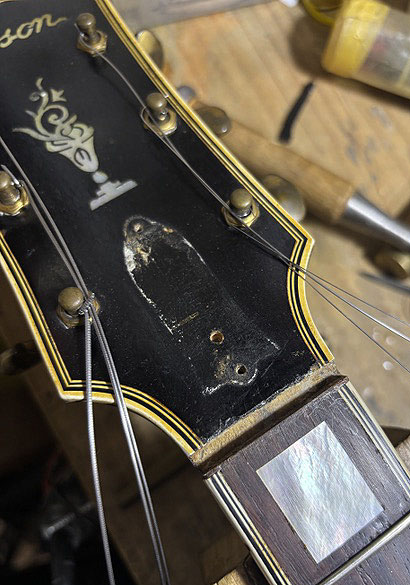
“The peghead overlay on these instruments was not cut open to give access to the truss-rod pocket. The factory workers used a knife for this purpose, resulting in a wide variety of shapes in truss-rod overlay openings in the Gibson-brand instruments.”
“Having said that, I have never seen an upper-tier Gibson-brand instrument with this aberration until now!”
Unfortunately, none of the above explains the absence of an access hole beneath the truss rod cover or the fact that the guitar has parallel, rather than X, top bracing!
Assuming that Joe is right and the guitar was returned to Kalamazoo in 1940s to be re-necked, perhaps the top was replaced at the same time? This would at least explain the parallel braced top but, for now at least, the absence of truss rod access will have to remain a mystery!
At first glance, the fingerboard appears to be rosewood, suggesting it was worked on during World War II, when ebony was no longer used.I have a 1936 L5 and it is parallel braced and original