
A question often asked by vintage archtop guitar enthusiasts is: “When did Gibson abandon its tastefully understated dot fingerboard inlays in favour of a series of large pearl blocks?” Below, we attempt to provide an answer but discover that – as with all things Gibson – the transition from one style to another is far from neat and tidy.
The First Block-Neck L-5s
The switch from dot to block fingerboard inlays took place at a time when Gibson was making several other changes to its flagship archtop model. As a result, it’s often thought that all block neck L-5s have a 19-fret fingerboard with a square end, kerfed tone bars, a long pickguard, individual tuners and a regular – as opposed to a ‘wrap-over’ – tailpiece. As we are about to see, this simply isn’t the case.
The L-5 with block fingerboard inlays made its first ‘official’ appearance in Gibson’s 1931 ‘Road to Happiness’ fold-out brochure, then subsequently in 1932’s Catalogue U, where the model was described as having “large pearl position markers”.
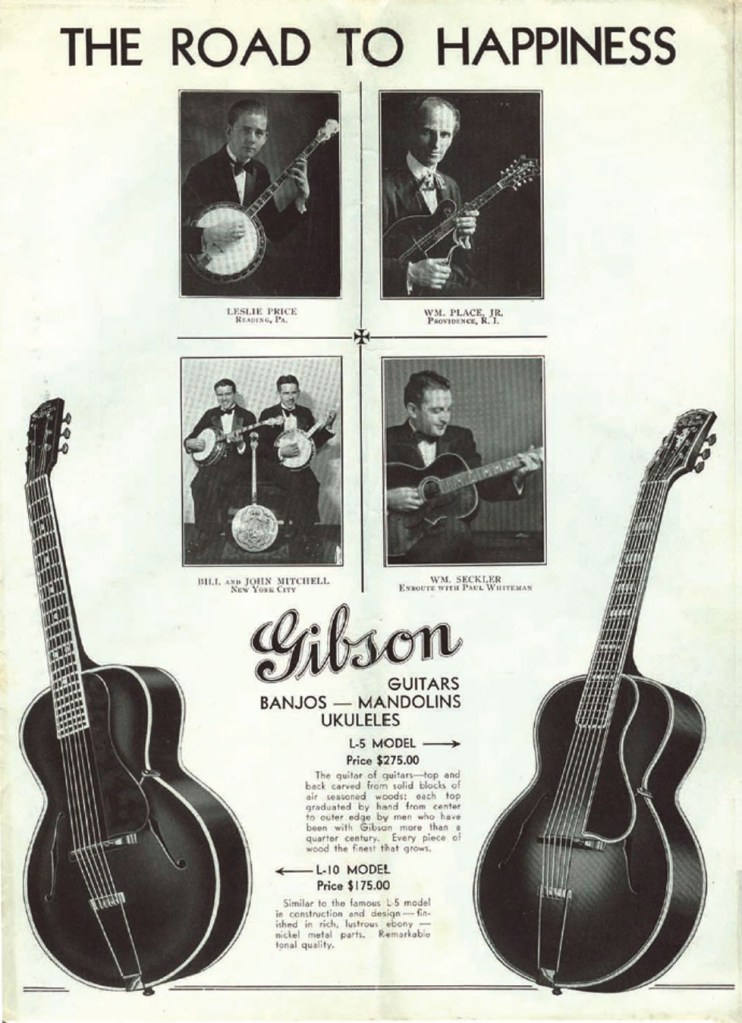
The L-5 with block fingerboard inlays made its first ‘official’ appearance in Gibson’s 1931 ‘Road to Happiness’ brochure, above
Both of the above show the L-5 with the then new long pickguard, pearl (or pearloid) block inlays from the third to the 15th frets and an old-style wrap-over tailpiece. The fingerboard still has the pointed end found on earlier dot neck L-5s and the headstock carries the horizontal pearl ‘The Gibson’ inlay. Catalogue U describes the model as a having “new individual tuning pegs” (i.e. gold-plated Grover 98G ‘Sta-tite’ Tuners).

Gibson’s catalogue U of 1932
Eddie Lang
Seminal jazz guitarist Eddie Lang can be seen accompanying Bing Crosby in the full-length movie ‘The Big Broadcast.’ The number is ‘Please’ and Eddie is playing a block neck L-5. Bing began filming the ‘The Big Broadcast’ in June of 1932 and the movie was released in October of that year.
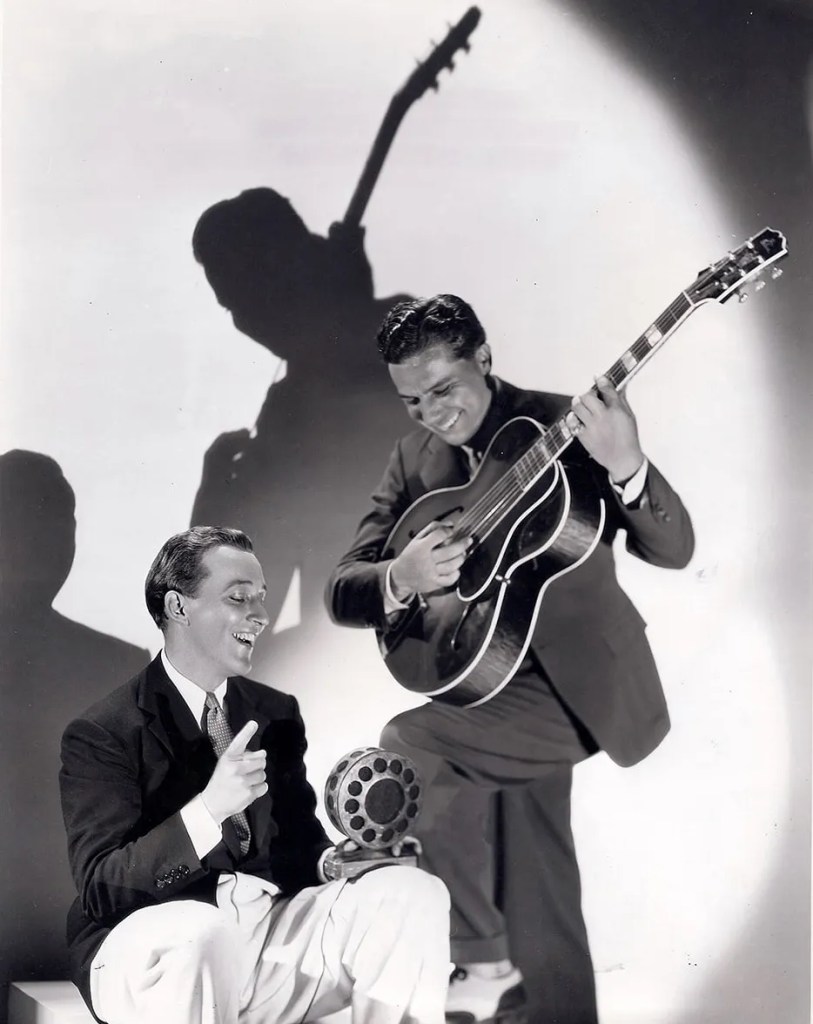
Eddie Lang is seen here with crooner Bing Crosby in the 1932 film, ‘The Big Broadcast’
Earlier still, Eddie plays a block neck L-5 in the short film, ‘A Regular Trouper’, which stars singer Ruth Etting and was released on April 17th 1932.

Eddie Lang appears in the short film, ‘A Regular Trouper’, which was released in April of 1932
This confirms that Gibson was shipping L-5s with a block-inlaid neck at least as early as April 1932 – and likely earlier, since filming of ‘A Regular Trouper’ would have preceded its release date by some months.
According to guitar historian Robb Lawrence, L-5 serial number 88368 belonged to Eddie Lang. The guitar was shipped in March of 1932, so this may be the guitar that Eddie is seen playing in the above-mentioned films.
Early 1930s examples
Two of the earliest block neck L-5s on our website are serial numbers 85576 and 85758, both of which were shipped in 1930.
The FON of serial number 85576 indicates that it was produced about mid-year 1929. Both guitars have celluloid block inlays, a fingerboard with a pointed end and a Master Model label.
Celluloid (pearloid) block inlays are thought to have preceded genuine pearl block inlays, so it seems unlikely that either of these guitars was returned to the factory to have a new fingerboard fitted so soon after it was initially shipped. Of course, it’s possible that they left the factory with dot inlays and were returned to Kalamazoo to be ‘updated’ with the new style block inlays, which could have been added to the original fingerboard.
Joe Spann tells us that there is no evidence in the extant Gibson shipping ledgers (March 1935 through January 1953) to indicate that L-5 serial number 85576 was sent back to the factory for repairs during that period, though it may have been returned at some point between 1930 and March 1935.
L-5 serial number 85758 was returned to the factory for repairs circa late 1935 or early 1936. However, if the fingerboard inlays were replaced at this point it seems likely that genuine pearl (rather than pearloid) would have been used.
Were dot and block neck L-5s shipped over the same time-period?
Did Gibson continue to ship dot neck L-5s after the introduction of the new block neck version? The answer appears to be ‘yes’. The majority of L-5s that we have come across with a 1931 shipping date have a dot inlaid fingerboard. By the following year the situation is reversed and most L-5s now have a block inlaid fingerboard. Having said that, there are dot neck L-5s with 1932 and even 1933 serial numbers, though by this point most L-5s had block fingerboard inlays.
Summary
The L-5 with a block fingerboard debuted in Gibson’s 1931 ‘Road to Happiness’ brochure and Eddie Lang can be seen playing one in the short film, ‘A Regular Trouper’, which was released in April 1932. If L-5 serial number 85576 and L-5 serial number 85758 have their original fingerboards, then the first block neck L-5s were produced as early as 1930 but we are going to go with 1931 as the first year for the block neck L-5 – somewhere in the 87—/88— serial number range.